
From boring to wow: Tellable inspires children to start reading through a design thinking-led storytelling workshop

Updated: Jul 21, 2025
June 19th is more than a regular Thursday – it’s a reminder to get off our screens and connect with the written word. For Tellable, National Reading Day was the perfect opportunity to inspire young children to read again.
When bringing ideas to an audience, the easy way of doing things would be creating a presentation and telling each child they should pick up a book and start reading right away. We could take children through multiple slides on the joys of reading – regardless of their waning attention spans – and come away feeling we’d done what we could.
But that’s not how we roll at Tellable. And Janaki Sabesh, renowned Storyteller and public speaking veteran, felt the same. Our founder decided to approach a school with the intention of understanding the decline of reading habits a little better. Why make sweeping generalisations about today’s children when we could just ask them?
The school was immediately excited about the idea, which meant we were excited, and we could only hope the children would be too. By combining our design-thinking approach, and Janaki ma’am’s expertise, an idea began to take shape.
Putting the children in focus was the first step. In order to find a solution, we needed to understand the problems. How do the children spend their free time? What’s stopping them from reading? And what do they need to start?
That’s where the design-thinking framework came in. By talking with the children – instead of at them – and encouraging them to participate, we could co-create a solution.
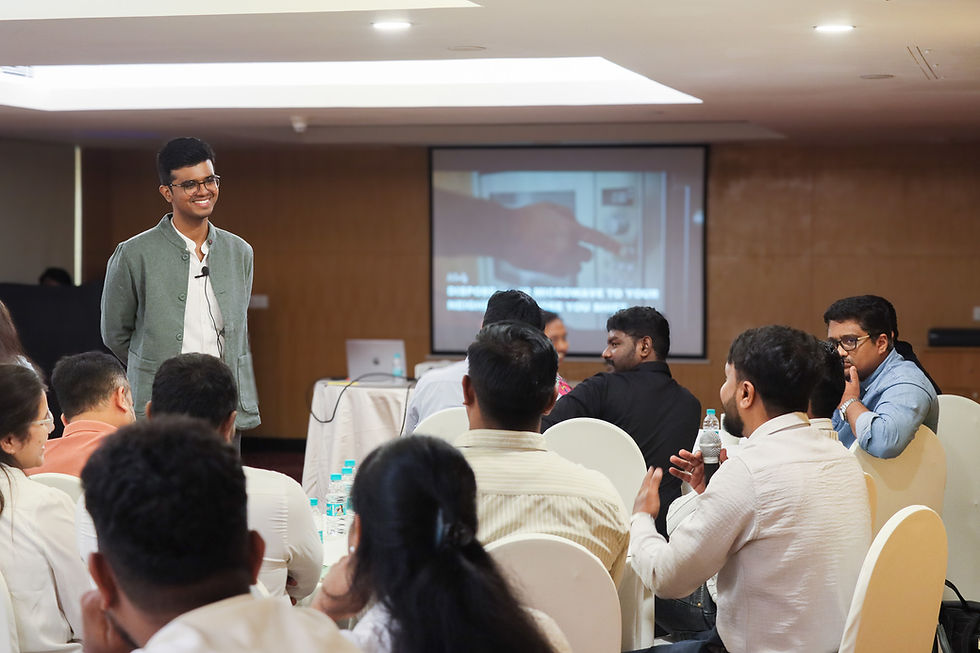
So we did a survey: because of course, what is a design solution without user inputs, right? But it wasn't your run-of-the-mill Google Forms survey. We asked the students to become human bar graphs -- first we showed them questions on screen, and then got them to line up in columns based on their answers.
In asking the children about their reading habits, their parents’ reading habits, and their overall thoughts on books, we came to realise something. Three somethings, actually.
'Watching YouTube is more joyful than reading'
The first was that it’s easier to watch something than it is to read it.
Reading takes effort, but a movie is a breeze. And while we don’t disagree on the excitement of cinema, we wanted to challenge this idea. We opened YouTube, and showed the children a snippet from Harry Potter and the Philosopher’s Stone – specifically the part when Harry approaches the Mirror of Erised and sees his parents looking back at him.
Then we showed the children the same passage from the book, and asked them to read it.
After this exercise, we asked the children – how did you feel watching the clip? How was it different from reading the passage?
The unanimous answer we received was both surprising, and heartening. Based on their answers, the written passage allowed the children to imagine the scene better, and experience what the character was feeling. It was a far more immersive experience than the movie – a conclusion they were able to come to themselves, without being told to.
This was the result we wanted.
We didn’t want to dump ideas or beliefs onto children and expect them to blindly agree; we wanted them to try and see on their own how reading could be fun. That’s what sticks with you, more than a fancy PPT or a boring classroom lecture.
'What if I encounter hard words when reading?'
But then came the next hurdle – what if they found it hard to read the words? What if the words were unfamiliar and intimidating? What if they weren’t confident about navigating English language books?
That’s the beauty of books: stories transcend language. A good story will make you feel, and you don’t need fancy words to do it. So we showed the children just that – we gave them a story that used simple words, and was easy to read, and the difference was stark. Suddenly, reading wasn’t scary anymore. Language was no longer a barrier. Minds were being changed right before us.
Excitement was in the air!
'Where do I start? How do I choose a book?'
Things looked promising, but we had one final bridge to cross. The children were excited and ready to start reading. “But,” they asked, “where do we start?”
“How do you know what books to choose?”
Technology can be mighty useful in times like this. Yes, we want children to spend less time online, but not all screen time is bad screen time!
We took the children on a journey to a land called ChatGPT – ask, and you shall receive.
If a child likes outer space, we asked for books on space. If another child liked dinosaurs, we asked for books on dinosaurs.
Suddenly, the vast, unfathomable world of books was within reach. Now the children had titles and authors to look for, and worlds to explore. Our work here was done.
It turns out, however, that the children had just gotten started.
The impact of combining design thinking and storytelling on children's habit building
The day after the workshop ended, our founder and workshop convener Ayyappan Ramachandran received a message from one of the children’s parents. The child’s mother happened to be a teacher at the same school, and had wanted to know what the workshop was all about. “My son wants to try reading a book”, she said, “and he wants me to start reading too.”
Not only was this child excited to explore the world of books himself, he wanted his parents to share in the excitement. A budding change-maker, transforming the world one adult at a time.
All it took was one day.
We set out to make students readers, and now they are carrying the baton forward.
Knowing this, can we truly say our work is done? Perhaps, when every child out there is telling their loved ones, “Let’s read together.”
Until then, Tellable will keep pushing forward.

Comments