
Thinking outside the pitch: We enabled Airtel’s B2B sales teams to listen and sell with stories

Updated: Jan 5
A successful sale takes research, perseverance and strategic positioning, and is a skill built up over years of learning and unlearning. But pitching a product to a prospect is more than just relying on its shiny exterior. Customers need to not only understand what the product is, but also – and more importantly – how it can actually help solve their problems.
Previously, Tellable helped a Fortune 500 company achieve just this, transforming a sales interaction into a compelling conversation between two people. It gave the company’s sales teams immense confidence, leading to real impact on their sales performance. We wanted to help other businesses achieve the same.
Airtel Business was one company whose interest was immediately piqued. They felt Tellable could help their Key Account Managers (KAMs) move the needle further.
KAMs at Airtel Business work with customers across diverse sectors – from government departments, PSUs, mid-tier businesses, to large enterprises – and the teams are equipped with expert product knowledge that helps them fulfil client needs with precision and efficiency.
But every vertical comes with its own unique challenges. This is where the sales leadership at Airtel Business wanted to explore storytelling.
Addressing specific B2B sales challenges through storytelling
Enter the government sales vertical. We listened as the head of the team explained the challenges of communicating with IAS officers and heads of PSUs who simply have no time to listen, given their packed schedules.
Moreover, he was worried that his sales team was simply fulfilling the requirements given to them, nothing less, but also nothing more. While they were executing orders perfectly, they were unable to take that extra step of selling by creating demand.
To summarise, the team was facing two key issues:
How do you sell to someone who doesn’t have time to listen?
How do you identify and create demand beyond what the client has expressed?
(Spoiler alert: Storytelling. But we’ll get to that.)
In order to understand the as-is communication style of the KAMs, we created a questionnaire for them to fill out, asking them how they respond to different sales situations. This would then let us customise our story-driven sales enablement workshop to help work through their specific challenges.
The workshop was a half-day affair, aimed at helping each team member understand how they could express themselves and communicate Airtel products without losing the interest of a time-bound stakeholder.
In a way, we were speaking with a time-bound audience ourselves – how could we keep our participants’ attention, and encourage them to fully engage with the workshop curriculum? Through interactive activities and exercises, with scenarios they could personally relate to.
The workshop unfolded a little like this:
Context setting: Why use storytelling in B2B sales? What would it look like for you?
Role-play to understand common sales mistakes: Here is a real-world scenario outside of your workplace. Use your sales skills to dispose an used microwave to your neighbour.
Active listening: Listening is more important than speaking. How do you engage your customer(s) in a conversation where they do the talking?
Show, don't tell: What is the difference, why is it impactful?
Storytelling elements: What makes up a story? Can you identify when these elements are absent?
Humanising technology: How to apply these storytelling principles to a technical, lifeless product?
Putting stories to test in real-world scenarios: Tackling the two challenges reported by the department head.
Asking curious, context-led questions and telling ultra-short credible stories to time-starved prospects in order to get a longer meeting
Using probing stories during discovery phase to unearth latent needs and challenges in order to upsell or cross-sell
Team quiz: Are you a good storyteller? Fight your colleagues to win the top spot.
This way, our participants could progressively pick up and test out their own storytelling skills, polishing where needed; after all, everyone is a storyteller, and in that way, also salespeople. A storyteller sells an idea, and a salesperson sells a story…or is it the other way round?
But we didn’t stop with the workshop: to ensure team members had thoroughly absorbed what they had learnt, we conducted two virtual check-ins, post the actual workshop. It allowed us to do case studies and role-plays, especially involving hypothetical scenarios of selling to time-starved prospects and up- or cross-selling within an account, evaluate their progress, and provide feedback where needed.
Then we sent out one more questionnaire – how would they respond to common sales situations now? What had changed since the training?
A lot, it would appear.
One KAM showed us just how quickly one can progress when equipped with the right training. At the start of the training, when asked to do a sales pitch, the participant had used technical terms, jargon, and explained the product not unlike a catalogue.
Straight-forward, technically accurate, but lacking an emotional connection.
Yet this same participant now delivered something completely different. It was simple, relatable, and held the audience’s interest. By tapping into empathy, by communicating the value and impact of Airtel’s solutions on real people’s lives, the team members were able to turn a pitch into a human-interest story.
Storytelling had changed their mindset on how to use and tell stories, where to use them and what kind of stories to tell depending on the direction the sales conversation takes.
Because that’s what a sale should be – a conversation. The moment your customer is ready to listen, the door opens to a trust-based relationship.
If you go the extra mile, you can help the client discover gaps that they never realised, and fill them accordingly. You create demand by listening, understanding, and identifying; and like that, you go from simply fulfilling a need to tangibly improving a customer’s experience.
How do you codify sales storytelling?
Following the success of our workshop with the government sales vertical came a request from Airtel Business's enterprise sales vertical. Here, however, the challenge was a little different: how could we codify storytelling?
The enterprise sales leader wanted his team members to have a clear, structured formula in mind when speaking with CIOs and CTOs of large enterprises. Was there a way to achieve this, so that team members wouldn’t have to think on the spot to tell a story?
With storytelling, there’s a solution for every problem. Introducing CLEAR, a structure we crafted to make sales storytelling memorable, and well, clear:
C: Challenge of the customer
L: Losses if the challenge is not addressed
E: Efforts taken by the customer to curb the challenge, but ineffective
A: Airtel solution to permanently resolve the challenge
R: Results of the Airtel solution, tying back to ‘C’ and ‘L’
This time, we conducted a full-day workshop to train enterprise KAMs on how they could use CLEAR to come up with compelling stories when speaking with customers.
The first half, dedicated to theory, took the sales team through the benefit of stories, what a story is, what it’s not, and how to use CLEAR as a guideline across different applications like product positioning, objection handling, data storytelling, etc. This gave the team a solid foundation which they could then use in the second half of the day, in the practical module.
Here, the session was completely interactive – we conducted a fun and engaging sales storytelling quiz that had the KAMs boisterously competing in teams, followed by case studies and role-playing to simulate real-world sales scenarios.
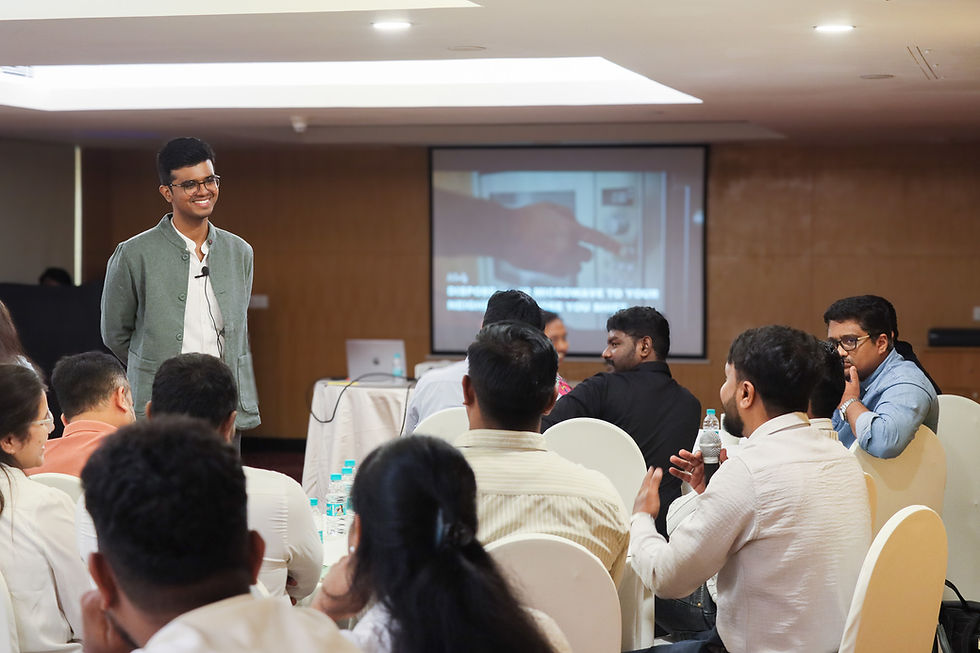
A successful storyselling session at Airtel's Delhi HQ
As with our previous workshop, the goal here wasn’t to just talk stories, but to ensure that the team was thorough in their understanding of sales storytelling, and confident in actually using stories – in this case, the CLEAR formula – as a tool in selling Airtel Business solutions to enterprise leaders.
We were honoured to hear that the enterprise sales leadership found great value in our program held in Airtel's Gurgaon HQ, and wanted us to take our workshop across the country to the rest of their teams in Mumbai, Bangalore and Chennai. And we did. Over four cities, and 120+ enthusiastic participants, we were able to help Airtel Business's sales personnel bring out the storytellers within them!
B2B sales enablement through storytelling
In short, like an Airtel network tower that connects people across cities, storytelling brings sales teams and prospects together, building relationships of trust and compassion that stand the test of time.
We can help your sales team tell purposeful stories. Let’s connect.


Comments